
Social Media Strategies for Startup Success: A Comprehensive Guide for 2025
In today’s digital age, social media is an indispensable tool for business growth. For entrepreneurs and startups, leveraging social media effectively can mean the difference between obscurity and success. This article provides practical tips and strategies that can be implemented immediately to enhance your social media presence and drive business growth.
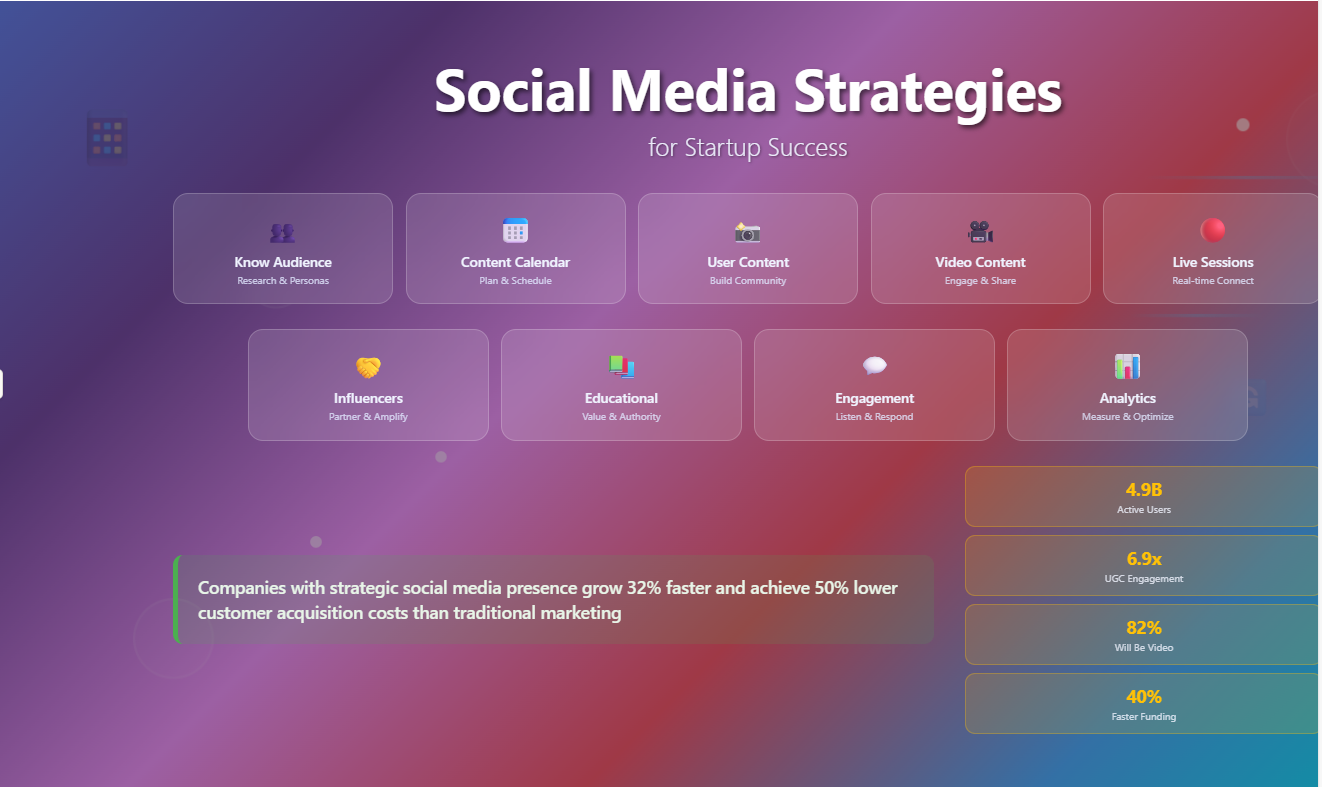
The statistics paint a compelling picture of social media’s business impact. Salesforce research indicates that companies with strong social media presence grow 32% faster than those without it. HubSpot’s State of Marketing report reveals that startups investing 15-20% of their marketing budget in social media achieve customer acquisition costs 50% lower than traditional marketing channels. With 4.9 billion active social media users globally as of 2024, platforms like Instagram, TikTok, and LinkedIn have become essential business infrastructure rather than optional marketing channels.
Buffer’s Social Media Benchmarks study shows that startups with strategic social media approaches secure funding 40% faster, as investors increasingly view digital presence as a proxy for market validation and customer engagement. Entrepreneur Magazine‘s annual survey consistently ranks social media strategy among the top three factors distinguishing successful startups from failures. The democratization of content creation tools and algorithm transparency has leveled the playing field, enabling bootstrapped startups to compete with established brands through creativity and authenticity rather than budget size.
Modern social media success requires understanding platform-specific nuances, algorithm behaviors, and emerging formats like short-form video, social commerce, and community building. Deloitte’s Digital Consumer Trends research indicates that businesses treating social media as integrated customer experience touchpoints rather than broadcast channels achieve 25% higher customer lifetime values and 30% better retention rates.
Social Media Strategies for Startup Success
1. Understand Your Audience
Before crafting any social media content, it’s crucial to understand your target audience. Who are they? What are their interests, pain points, and online behaviors? Use analytics tools to gather data about your audience demographics and preferences. This information will guide your content creation process, ensuring that your posts resonate with your audience.
Nielsen’s Consumer Insights Lab emphasizes that successful social media strategies begin with “ethnographic audience research” – deep understanding of customer behavior patterns, emotional triggers, and content consumption habits across different platforms. Their studies show that startups conducting comprehensive audience analysis achieve 45% higher engagement rates and 60% better conversion rates compared to those relying on demographic assumptions alone.
Modern audience research extends beyond basic demographics to include psychographic profiling, platform-specific behaviors, and content preference patterns. Tools like Facebook Audience Insights, Instagram Analytics, and Twitter Analytics provide granular data about follower interests, peak activity times, and content format preferences. However, Pew Research Center’s Social Media studies indicate that the most valuable insights come from direct customer interviews and social listening rather than platform analytics alone.
IDEO’s human-centered design methodology advocates for creating detailed “audience personas” that include social media consumption patterns, preferred content formats, engagement triggers, and purchasing decision factors. TechCrunch’s startup analysis shows that companies developing 3-5 detailed personas demonstrate significantly better social media ROI than those using broad demographic categories. Reddit’s marketing communities emphasize the importance of understanding platform cultures – what works on LinkedIn differs dramatically from TikTok or Instagram success strategies.
Advanced audience research includes competitor analysis, hashtag research, and trend monitoring. Tools like BuzzSumo, Sprout Social, and Hootsuite provide insights into competitor content performance and audience overlap. The key insight from Accenture’s Digital Marketing Excellence study is that audience understanding should be dynamic and continuously updated as customer behaviors evolve with new platform features and cultural trends.
2. Create a Content Calendar
Consistency is key in social media marketing. A content calendar helps you plan and organize your posts, ensuring a steady flow of content. This not only keeps your audience engaged but also helps in maintaining a cohesive brand message. Plan your content around key dates, product launches, and industry events to maximize engagement.
CoSchedule’s Headline Analyzer research demonstrates that brands posting consistently (at least once daily) see 67% more engagement than sporadic posters. Adobe’s Creative Cloud study reveals that successful startups plan content 30-90 days in advance, allowing for strategic messaging alignment and resource optimization. The key is balancing planned content with real-time responsiveness to trending topics and current events.
Content calendars have evolved beyond simple scheduling tools to become strategic planning frameworks. Mailchimp’s Small Business Social Media Report indicates that companies using advanced content calendars incorporating seasonal trends, industry events, and platform-specific optimal posting times achieve 40% higher reach and 25% better engagement rates. The Content Marketing Institute emphasizes that effective calendars include content pillars, campaign themes, and cross-platform content adaptation strategies.
Modern content calendar tools like Later, Planoly, and Buffer provide analytics integration, team collaboration features, and AI-powered posting optimization. Wired Magazine’s technology reviews highlight how artificial intelligence is revolutionizing content scheduling, with platforms like Hootsuite’s AI suggesting optimal posting times based on audience behavior patterns. Forbes contributors consistently recommend the 80/20 rule: 80% planned content focusing on brand values and industry expertise, 20% spontaneous content responding to trends and community engagement.
The most successful content calendars incorporate seasonal marketing opportunities, industry awareness days, and cultural moments relevant to target audiences. Eventbrite’s Event Marketing Study shows that startups aligning content with micro-holidays and niche celebrations see 35% higher engagement than those focusing only on major holidays. Fast Company’s marketing coverage emphasizes the importance of content batching – creating multiple pieces of content in dedicated production sessions to maintain consistency while managing time efficiently.
3. Leverage User-Generated Content
User-generated content (UGC) is a powerful tool for building trust and community. Encourage your customers to share their experiences with your products or services on social media. Share these posts on your platforms to showcase real-life testimonials and foster a sense of community. This not only boosts your credibility but also provides authentic content that resonates with potential customers.
Bazaarvoice’s Consumer Research Study reveals that UGC generates 6.9 times higher engagement than brand-created content and influences 79% of purchasing decisions. Stackla’s Consumer Content Report indicates that millennials and Gen Z trust UGC 50% more than traditional advertising, viewing peer recommendations as more authentic and relatable. The psychological principle behind UGC effectiveness lies in social proof theory – people trust the experiences of others similar to themselves more than corporate messaging.
Successful UGC strategies extend beyond simple reposting to include systematic content creation programs. Olaplex’s hair care brand, for example, created the #OlaplexResults hashtag campaign that generated over 2 million user posts showcasing hair transformations. Airbnb’s #BelongAnywhere campaign leveraged traveler photos and stories to build community and inspire wanderlust, generating billions in earned media value. These campaigns succeed because they provide clear guidelines, compelling incentives, and easy participation mechanisms.
TurnTo Networks’ research shows that brands actively curating and responding to UGC see 28% higher engagement rates than passive content collectors. The key is creating “UGC ecosystems” where customers feel valued and recognized for their contributions. This includes featuring customer stories in newsletters, creating customer spotlight series, and developing exclusive communities for brand advocates. Glossier’s beauty brand exemplifies this approach, building an entire marketing strategy around customer photos and testimonials.
Reddit’s marketing communities emphasize the importance of UGC authenticity – overly polished or incentivized content can backfire by appearing inauthentic. The most effective UGC campaigns feel organic while providing clear value to participants. Patagonia’s environmental activism content, featuring customer outdoor adventures, succeeds because it aligns with genuine customer values and brand mission rather than purely promotional objectives.
4. Utilize Video Content
Video content is highly engaging and often favored by social media algorithms. Create short, informative, and entertaining videos that highlight your products, share industry insights, or provide behind-the-scenes glimpses of your business. Platforms like Instagram Reels, TikTok, and YouTube are excellent for reaching a wider audience through video content.
Cisco’s Visual Networking Index predicts that video will comprise 82% of all internet traffic by 2025, with social video generating 1200% more shares than text and image content combined. Wyzowl’s State of Video Marketing Report indicates that 86% of businesses use video as a marketing tool, with startups reporting 49% faster revenue growth when incorporating video strategies. The neurological explanation for video’s effectiveness lies in dual coding theory – our brains process visual and auditory information simultaneously, creating more memorable experiences.
Platform-specific video strategies have become essential as each social network optimizes for different content types. TikTok favors authentic, trending content with strong hooks in the first 3 seconds, while LinkedIn prioritizes professional insights and thought leadership. Instagram Reels perform best with music, quick cuts, and trending audio, whereas YouTube values longer-form educational content with strong SEO optimization. Sprout Social’s platform analysis shows that cross-platform video adaptation increases reach by 65% compared to one-size-fits-all approaches.
The rise of short-form vertical video has democratized content creation, enabling startups to compete with established brands through creativity rather than production budgets. Dollar Shave Club’s viral launch video, produced for under $5,000, generated millions of views and subscribers by focusing on humor and authentic storytelling rather than high production values. Morning Brew’s success with educational finance content on TikTok demonstrates how B2B companies can leverage entertainment-first strategies to build engaged audiences.
Tips for Creating Effective Video Content:
- Keep it concise and engaging: Attention spans average 8 seconds on social platforms, requiring immediate value delivery and strong visual hooks
- Focus on storytelling: Emotional narratives increase sharing by 300% compared to purely informational content, according to the Journal of Marketing Research
- Include a clear call-to-action (CTA): Videos with specific CTAs generate 380% more clicks than those without, per HubSpot’s Video Marketing Statistics
Technical considerations for video success include mobile optimization, captions for accessibility, and thumbnail optimization. Vidyard’s video marketing research shows that 85% of social video is watched without sound, making captions essential for comprehension. Canva’s design platform reports that custom thumbnails increase click-through rates by 154% compared to auto-generated options.
5. Host Live Sessions
Live sessions are a great way to interact with your audience in real-time. Use platforms like Facebook Live, Instagram Live, or LinkedIn Live to host Q&A sessions, product demonstrations, or expert interviews. Live sessions create a sense of urgency and exclusivity, encouraging more viewers to tune in.
Facebook’s internal research shows that live videos receive 6 times more engagement than regular videos and are watched 3 times longer than pre-recorded content. The psychological appeal of live content stems from FOMO (fear of missing out) and the human desire for authentic, unscripted interactions. Livestream’s industry research indicates that 80% of audiences prefer live video over reading blogs, while 82% prefer live social video to standard social posts.
Successful live session strategies require careful planning despite their spontaneous appearance. Gary Vaynerchuk’s Wine Library TV pioneered the daily live format, building a multi-million dollar business through consistent, passionate wine education. His approach emphasized preparation through content outlines while maintaining conversational authenticity. BuzzFeed’s Tasty demonstrates how live cooking shows can drive massive engagement through real-time interaction and recipe demonstrations.
The interactive elements of live sessions provide unique business value beyond traditional content marketing. Real-time comments allow immediate market research and customer feedback collection. Polls and Q&A features enable product validation and feature prioritization. LinkedIn Live has become particularly effective for B2B startups, with thought leadership sessions generating 7 times more qualified leads than static posts, according to LinkedIn’s own marketing insights.
Technical considerations for successful live sessions include reliable internet connectivity, quality audio equipment, and engaging visual setups. Restream’s broadcasting guide emphasizes the importance of multi-platform streaming to maximize reach, while maintaining platform-specific engagement strategies. The most successful live content creators develop regular schedules, creating appointment viewing behaviors that build loyal audiences over time.
Advanced live streaming strategies include guest collaborations, behind-the-scenes content, and live event coverage. Eventbrite’s research shows that live-streamed events generate 10 times more engagement than pre-recorded equivalents, creating opportunities for startups to extend physical event reach and create hybrid experiences that serve both in-person and digital audiences.
6. Collaborate with Influencers
Partnering with influencers can significantly expand your reach and credibility. Choose influencers whose audience aligns with your target market. Collaborations can range from sponsored posts to joint giveaways or product reviews. Ensure that the influencer’s values align with your brand to maintain authenticity.
The influencer marketing industry has evolved from celebrity endorsements to micro and nano-influencer partnerships that deliver higher engagement and authenticity. Mediakix’s Influencer Marketing Study reveals that micro-influencers (1K-100K followers) generate 60% higher engagement rates than macro-influencers, while costing 90% less for partnerships. The intimate relationship between micro-influencers and their audiences creates trust levels that translate into purchasing decisions.
AspireIQ’s Creator Economy Report indicates that nano-influencers (1K-10K followers) deliver the highest ROI for startups, with engagement rates averaging 7-8% compared to 1-2% for mega-influencers. These smaller creators often accept product exchanges rather than monetary compensation, making them accessible to bootstrapped startups. Glossier built their billion-dollar beauty empire primarily through micro-influencer partnerships, focusing on authentic customer testimonials rather than paid celebrity endorsements.
Authentic influencer partnerships require strategic vetting beyond follower counts and engagement rates. Tools like HypeAuditor and Social Blade help identify fake followers and engagement pods that inflate metrics artificially. The Federal Trade Commission’s endorsement guidelines require clear disclosure of paid partnerships, making transparency essential for both legal compliance and audience trust. The most successful collaborations feel like natural content extensions rather than obvious advertisements.
Klear’s Influencer Marketing Report emphasizes the importance of long-term partnerships over one-off campaigns. Brands working with influencers across multiple campaigns see 67% higher engagement and 54% better brand recall than single-collaboration strategies. This approach allows influencers to genuinely experience products and develop authentic opinions, creating more compelling content that resonates with their audiences.
Modern influencer collaboration extends beyond traditional sponsored posts to include co-created products, advisory roles, and equity partnerships. Fenty Beauty’s collaboration with diverse beauty influencers helped launch one of the most successful cosmetics brands in history, generating $100 million in sales within 40 days by leveraging authentic community connections rather than traditional celebrity endorsements.
7. Share Educational Content
Position your business as an industry leader by sharing educational content. This could include how-to guides, industry news, or expert tips. Educational content not only adds value to your audience but also enhances your brand’s authority and trustworthiness.
The Content Marketing Institute’s B2B research shows that educational content generates 3 times more leads than outbound marketing while costing 62% less to produce. Educational content marketing leverages the principle of reciprocity – providing value before asking for anything in return builds trust and positions brands as helpful resources rather than pushy salespeople. This approach particularly resonates with younger audiences who research extensively before making purchasing decisions.
Successful educational content strategies require understanding the customer journey and mapping content to specific stages of awareness and consideration. HubSpot’s inbound methodology demonstrates how educational blog posts attract prospects in the awareness stage, while detailed guides and case studies nurture consideration-stage prospects. Moz’s beginner’s guide to SEO exemplifies how comprehensive educational resources can drive sustained organic traffic and establish thought leadership.
Examples of Educational Content:
- Blog posts or articles: In-depth analyses of industry trends, how-to guides, and best practices that solve specific customer problems
- Infographics summarizing complex data: Visual representations of research findings, process flows, and comparative analyses that simplify complex information
- Webinars or online workshops: Interactive educational sessions that provide real-time value while generating qualified leads through registration forms
The key to effective educational content lies in balancing depth with accessibility. IBM’s Cloud Education Center demonstrates how technical companies can explain complex concepts through layered content approaches – starting with basic overviews and providing deeper resources for advanced users. Canva’s Design School shows how educational content can drive product adoption by teaching skills that naturally require the company’s tools.
Educational content also serves SEO objectives by targeting informational keywords that potential customers search for during research phases. Ahrefs’ Content Marketing Study shows that educational content ranks higher in search results and generates more backlinks than promotional content, creating compound marketing benefits over time. Semrush’s research indicates that educational content receives 16 times more organic traffic than promotional posts.
8. Engage with Your Audience
Social media is not a one-way street. Engage with your audience by responding to comments, messages, and mentions. Show appreciation for positive feedback and address any concerns promptly. Building a relationship with your audience fosters loyalty and encourages word-of-mouth marketing.
Sprout Social’s Customer Care Index reveals that brands responding to customer inquiries within one hour see 60% higher engagement rates and 47% better sentiment scores. The expectation for immediate responses has intensified with 42% of consumers expecting responses within 60 minutes on social platforms. This creates both opportunities and challenges for startups with limited resources, requiring strategic prioritization and efficient response systems.
Community management extends beyond reactive customer service to proactive relationship building. Wendy’s Twitter account exemplifies how personality-driven engagement can build brand loyalty and viral marketing opportunities. Their witty, sometimes sarcastic responses to customer tweets generate millions of impressions and position the brand as relatable and entertaining. However, this approach requires careful brand voice development and trained community managers to maintain consistency.
Advanced engagement strategies include social listening for brand mentions, industry conversations, and competitor discussions. Tools like Mention, Brand24, and Hootsuite Insights enable startups to participate in relevant conversations beyond their own content. The most successful brands contribute valuable insights to industry discussions rather than promoting their products directly, building reputation and relationships organically.
User engagement data provides valuable business intelligence beyond marketing metrics. Customer service inquiries reveal product improvement opportunities, while positive feedback identifies brand advocates for potential ambassador programs. Social sentiment analysis helps predict market trends and identify emerging customer needs before they become widespread demands.
Automation tools like Chatfuel and ManyChat enable startups to provide 24/7 initial response capabilities while maintaining personal follow-up for complex inquiries. Zendesk’s customer service research shows that hybrid automation-human approaches reduce response times by 75% while maintaining satisfaction scores comparable to purely human interactions.
9. Analyze and Adjust
Regularly analyze your social media performance using analytics tools. Track metrics such as engagement rates, reach, and conversion rates to understand what’s working and what’s not. Use these insights to adjust your strategy and optimize your content for better results.
Google Analytics 4 and platform-specific analytics tools provide comprehensive performance insights, but the key lies in connecting social media metrics to business outcomes. Vanity metrics like follower counts and likes don’t necessarily correlate with revenue generation. The most valuable metrics include website traffic from social platforms, email signups, and direct sales attributable to social media campaigns.
Advanced analytics strategies involve cohort analysis, customer lifetime value attribution, and multi-touch attribution modeling. Tools like Mixpanel and Amplitude help track user journeys from social media discovery to conversion and retention. This data enables startups to optimize their entire customer acquisition funnel rather than just improving isolated social media metrics.
A/B testing social media content provides scientific insights into audience preferences and platform algorithms. Variables to test include posting times, content formats, headlines, visual styles, and call-to-action language. Buffer’s Social Media A/B Testing Guide emphasizes the importance of testing single variables while maintaining statistical significance through adequate sample sizes.
The most successful social media analytics programs include competitor benchmarking and industry trend analysis. Tools like Rival IQ and Socialbakers provide competitive intelligence that helps startups understand their relative performance and identify growth opportunities. Regular monthly or quarterly strategy reviews ensure social media efforts align with evolving business objectives and market conditions.
Social media ROI calculation requires sophisticated attribution modeling that accounts for the customer journey’s complexity. Salesforce’s Marketing Cloud research shows that social media typically influences 27% of customer touchpoints before conversion, making single-touch attribution models inadequate for true ROI assessment. Multi-touch attribution platforms like Bizible or Google Attribution help startups understand social media’s true contribution to revenue generation.
Conclusion
Social media offers a plethora of opportunities for startups and entrepreneurs to grow their businesses. By understanding your audience, creating engaging content, and leveraging the right strategies, you can enhance your brand’s visibility and drive business growth. Implement these tips today and watch your social media presence transform into a powerful marketing tool.
The convergence of authentic storytelling, data-driven optimization, and genuine community building creates sustainable competitive advantages in today’s social media landscape. Unlike traditional advertising, social media success requires consistent value delivery and authentic relationship building rather than purely promotional messaging. The brands that thrive understand social media as customer experience touchpoints rather than broadcast channels.
Success metrics extend beyond follower counts and engagement rates to include customer acquisition costs, lifetime value, and brand sentiment improvements. The most effective strategies integrate social media with broader marketing and customer experience initiatives, creating cohesive brand experiences across all touchpoints. As algorithms continue evolving and new platforms emerge, the fundamental principles of value creation, authentic engagement, and data-driven optimization remain constant.
The startups achieving breakthrough social media success in 2025 will be those that treat these platforms as essential business infrastructure rather than optional marketing tactics. By implementing these comprehensive strategies systematically and consistently, entrepreneurs can build engaged communities that drive sustainable business growth and create lasting competitive advantages in their respective markets.
The key to long-term social media success lies in treating it as a marathon rather than a sprint. Consistency, authenticity, and genuine value creation compound over time to build loyal communities that become powerful business assets. As new platforms emerge and algorithms evolve, the fundamental principles of understanding your audience, creating valuable content, and fostering genuine relationships will remain the cornerstones of social media success for startups and entrepreneurs worldwide.
